
 (EN)
(EN)
Economic Outlook: Uncertainty is Here to Stay, So What's Next?
Written by The Inspired Investor Team
Published on January 14, 2026
minute read
Share:


If there was one word to sum up last year’s economic outlook, it would have been “uncertainty.” Tariffs, trade tensions, lingering inflation and geopolitical risks dominated headlines. Thankfully, Canada exceeded expectations and avoided a recession that many thought was inevitable, but one thing is now clear: the uncertainty isn’t going away.
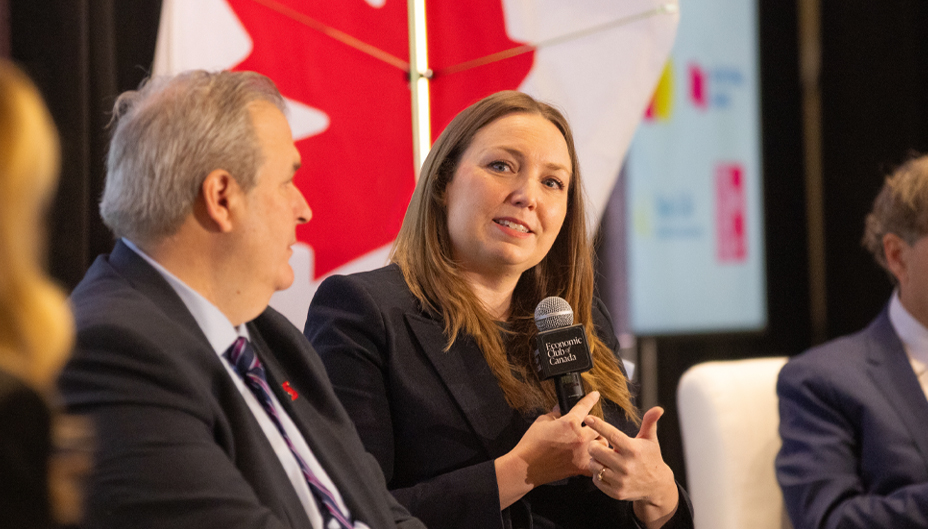
Because of that, uncertainty can no longer be used as an excuse to delay bold steps toward building a stronger Canadian economy. That was one of the main messages the country’s leading economists – including Frances Donald, RBC’s Chief Economist – delivered at the Economic Club of Canada’s 24th Annual Economic Outlook Breakfast in January.
There’s reason to be optimistic that the country is heading in the right direction in 2026, Donald says. Namely, Ottawa’s renewed effort to attract investment and spur long-term growth. RBC Economics’ outlook for 20261 mentions some of the fiscal strategies that could help, including things like targeted government incentives and spending to boost growth and confidence, which would help accelerate business investment.
“What we’re seeing now is a transition towards relying more on targeted policy that can go directly into regions and sectors that need it most, which is something the Bank of Canada can’t do,” Donald said during the panel. “This is going to be very positive.”
Regional differences
Although the Canadian economy appeared resilient in 2025, that strength masked significant differences between provincial and regional economies. “We have to be cautious about saying the economy is resilient,” said Donald. “In some places, the economy is growing twice as fast as the national average, like in Alberta, and other places, there’s still a lot of pain that’s going to take a lot of time to recoup.”
The shift to a more targeted approach to economic policy is, in part, a reflection of these differences. Although the Canada-U.S.-Mexico Agreement (CUSMA) largely shielded Canada from the full impact of U.S. tariffs by keeping almost 90 percent of goods tariff-free, it has contributed to significant regional disparities. Ontario and Quebec, in particular, have been most affected by changes in U.S. trade policy.
“We don't spend enough time talking about how different our regional economies are and how Ontario is vastly different from Alberta, from Nova Scotia, from B.C.,” she said. “We need to double down on that or else we're going to hear more folks who don't feel represented by the conversation at the national level.”
Bank of Canada takes a back seat
In stark contrast to recent years, the Bank of Canada is largely expected to sit on the sidelines in 2026, even as inflation remains slightly elevated. There are two main reasons for this.
First, according to Donald, inflation in Canada is not currently driven by excessive consumer spending due to more disposable income. Instead, elevated costs are a result of supply-side factors, such as agricultural disruptions and tariffs. “We can cut and raise interest rates all we want. It's not going to impact inflation,” she said.
Secondly, regional disparities are limiting the central bank’s options. Although some parts of the country might benefit from a rate cut, for the country as a whole, Donald said it isn’t the right tool right now. As a result, RBC doesn’t expect any more rate cuts from the Bank of Canada this year.2
Stalling population growth
Slower population growth, in part due to tougher immigration policies, could have an effect on the rental market, the pool of available labour, wage growth and post-secondary funding.3 That shift could distort some of the economic signals about the health of the economy, said Donald.
For instance, she noted that in 2023 and 2024, the population grew so much that Canada needed a lot of job growth to keep the unemployment rate in check, but that’s no longer the case. With slowing – or even negative – population growth it’s possible to have very low hiring rates without significantly affecting employment levels. This could send mixed signals about whether the country is headed into a recession, explained Donald.
“Canada will actually be able to have no job growth this year and not see the unemployment rate rise,” she said. “We may see very low job growth, and people will be really worried this is a recession, when really it's a recalibration.”4
The future of trade
CUSMA may have shielded Canada from U.S. tariffs, but the future of this agreement will influence all economic forecasts. Negotiations to determine whether to extend this key trade agreement beyond its scheduled expiry in 2036 will begin this summer. If no extension is reached this year, CUSMA will remain in effect, with annual meetings held until 2036 to consider further extensions.
The broader focus of the negotiations, however, will be on the clause in the current agreement that allows any country to opt out with six months’ notice. While policymakers meet on the trade deal, Canada is still in the early phases of moving its economy towards new products and customers.
Already, there is some evidence that the private sector is adapting to U.S. and Chinese tariffs by increasing exports to other countries. RBC’s 2026 outlook notes that Canada’s exports to non-U.S. economies have been up year over year since March 2025, even though total and U.S. exports are down.
Regardless of what comes of the CUSMA negotiations, work to diversify the Canadian economy and put us on a positive path for the future will continue.
- RBC Economics, “Beyond the forecast: Six themes for Canada’s economy in 2026", January 2026
- RBC Economics, “BoC on hold while the Fed moves towards the sidelines”, December 2025
- RBC Economics, “Canada maintains tight immigration policy despite permanent resident exemptions", November 2025
- RBC Economics, “Canada’s shifting labour market: Recalibrating ‘breakeven employment’”, January 2026
RBC Direct Investing Inc. and Royal Bank of Canada are separate corporate entities which are affiliated. RBC Direct Investing Inc. is a wholly owned subsidiary of Royal Bank of Canada and is a Member of the Canadian Investment Regulatory Organization and the Canadian Investor Protection Fund. Royal Bank of Canada and certain of its issuers are related to RBC Direct Investing Inc. RBC Direct Investing Inc. does not provide investment advice or recommendations regarding the purchase or sale of any securities. Investors are responsible for their own investment decisions. RBC Direct Investing is a business name used by RBC Direct Investing Inc. ® / ™ Trademark(s) of Royal Bank of Canada. RBC and Royal Bank are registered trademarks of Royal Bank of Canada. Used under licence.
© Royal Bank of Canada 2026.
Any information, opinions or views provided in this document, including hyperlinks to the RBC Direct Investing Inc. website or the websites of its affiliates or third parties, are for your general information only, and are not intended to provide legal, investment, financial, accounting, tax or other professional advice. While information presented is believed to be factual and current, its accuracy is not guaranteed and it should not be regarded as a complete analysis of the subjects discussed. All expressions of opinion reflect the judgment of the author(s) as of the date of publication and are subject to change. No endorsement of any third parties or their advice, opinions, information, products or services is expressly given or implied by RBC Direct Investing Inc. or its affiliates. You should consult with your advisor before taking any action based upon the information contained in this document.
Furthermore, the products, services and securities referred to in this publication are only available in Canada and other jurisdictions where they may be legally offered for sale. Information available on the RBC Direct Investing website is intended for access by residents of Canada only, and should not be accessed from any jurisdiction outside Canada.
Explore More

AI Stocks: Making Sense of the Market Swings
What exactly is happening in the AI sector and how can investors make sense of it all?
minute read

7 Ways to Get Ahead Financially in 2026
How you might invigorate your finances and put your money to work more intentionally this year
minute read

3 things: Week of December 15
What the Inspired Investor team is watching this week
minute read
Inspired Investor brings you personal stories, timely information and expert insights to empower your investment decisions. Visit About Us to find out more.